
Tailor-Made Nanoporous Metal–Organic Frameworks Via Molecular Engineering for Bilirubin-Specific Capture from Liver Failure Patients’ Blood

Corresponding Author: Wenguo Cui
Nano-Micro Letters,
Vol. 19 (2027), Article Number: 48
Abstract
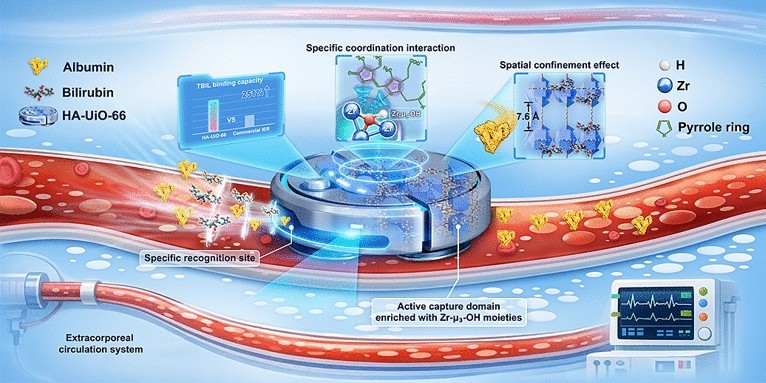
Overcoming the albumin–bilirubin binding barrier to achieve specific recognition and high-efficiency capture of blood bilirubin remains a major clinical challenge in treating patients with hyperbilirubinemia due to liver failure, cholestasis, or other related conditions. Here, a molecular engineering-assisted functionalization strategy is proposed: programming the coordination environment of nanocrystalline frameworks with monodentate carboxylic acid ligands of varied carbon chain lengths to construct a family of zirconium-based UiO-66 nanoporous frameworks that act as bilirubin-specific molecular capture traps. The experimental results and molecular dynamics simulations confirm that the newly engineered UiO-66 nanoporous framework rapidly enriched albumin-bound bilirubin through short-range van der Waals/electrostatic effects; the internal Zr–μ3–OH sites then formed directional Zr–pyrrole coordination with the bilirubin tetrapyrrole core, whereas albumin was physically excluded by the narrow apertures of the engineered nanoporous framework (average 7.6 Å), breaking the “albumin barrier” without competitive displacement. Dense intrapore hydrogen-bonding networks and π–π stacking further strengthen bilirubin-specific complexation. The computed adsorption energy (ΔEads = – 3.7 eV) indicates spontaneous, diffusion-limited capture. In simulated blood experiments, the newly developed UiO-66 nanoporous framework achieves an ultrahigh bilirubin removal rate of ~ 97.9% with negligible albumin loss. Finally, clinical tests on plasma samples from ten liver failure patients revealed a 251% higher bilirubin removal capacity per unit mass than that of the commercial ion exchange resin (IER) within 3 h, while albumin leakage remained ≤ 2.58% (vs. ≥ 8.53% for commercial IER). This study reveals, for the first time, the advantages and translational prospects of molecularly engineered nanocrystalline frameworks as a clinically viable platform for high-efficiency blood bilirubin removal.
Hightlights:
1 This work innovatively formulated a molecular engineering strategy for nanoframeworks, achieving precise customization of their nanoporous architectures.
2 This work developed a nanoscale bilirubin-specific capture trap, physically overcoming the critical trade-off between bilirubin removal and protein loss.
3 A groundbreaking 251% increase in total bilirubin capture capacity, coupled with an albumin loss rate of ≤2.58%, established a new world clinical assessment record.
Keywords
Download Citation
Endnote/Zotero/Mendeley (RIS)BibTeX
- M. Leslie, Can ‘toxic’ bilirubin be put to medical use? Science 380(6649), 1002–1003 (2023). https://doi.org/10.1126/science.adj1034
- K. Lai, X.-L. Song, H.-S. Shi, X. Qi, C.-Y. Li et al., Bilirubin enhances the activity of ASIC channels to exacerbate neurotoxicity in neonatal hyperbilirubinemia in mice. Sci. Transl. Med. 12(530), eaax1337 (2020). https://doi.org/10.1126/scitranslmed.aax1337
- C. Carreira-Blanco, P. Singer, R. Diller, J.L. Pérez, Ultrafast deactivation of bilirubin: dark intermediates and two-photon isomerization. Phys. Chem. Chem. Phys. 18(10), 7148–7155 (2016). https://doi.org/10.1039/c5cp06971h
- H. Devarbhavi, S.K. Asrani, J.P. Arab, Y.A. Nartey, E. Pose et al., Global burden of liver disease: 2023 update. J. Hepatol. 79(2), 516–537 (2023). https://doi.org/10.1016/j.jhep.2023.03.017
- A. Jindal, S.K. Sarin, Epidemiology of liver failure in Asia-Pacific region. Liver Int. 42(9), 2093–2109 (2022). https://doi.org/10.1111/liv.15328
- S. Vento, F. Cainelli, Acute liver failure in low-income and middle-income countries. Lancet Gastroenterol. Hepatol. 8(11), 1035–1045 (2023). https://doi.org/10.1016/S2468-1253(23)00142-5
- K. Ocskay, A. Kanjo, N. Gede, Z. Szakács, G. Pár et al., Uncertainty in the impact of liver support systems in acute-on-chronic liver failure: a systematic review and network meta-analysis. Ann. Intensive Care 11, 10 (2021). https://doi.org/10.1186/s13613-020-00795-0
- D.C. Carter, X.-M. He, S.H. Munson, P.D. Twigg, K.M. Gernert et al., Three-dimensional structure of human serum albumin. Science 244(4909), 1195–1198 (1989). https://doi.org/10.1126/science.2727704
- Y. Xie, Y.A. Kaiyum, L. Gu et al., A pair of DNA aptamers that can selectively bind to bilirubin and biliverdin. ACS Chem. Biol. 20(8), 2028–2037 (2025). https://doi.org/10.1021/acschembio.5c00438
- O. Alkhamis, C. Byrd, J. Canoura, A. Bacon, R. Hill et al., Exploring the relationship between aptamer binding thermodynamics, affinity, and specificity. Nucleic Acids Res. 53(6), gkaf219 (2025). https://doi.org/10.1093/nar/gkaf219
- Y. Zhang, C.-L. Mei, S. Rong, Y.-Y. Liu, G.-Q. Xiao et al., Effect of the combination of hemodialysis and hemoperfusion on clearing advanced glycation end products: a prospective, randomized, two-stage crossover trial in patients under maintenance hemodialysis. Blood Purif. 40(2), 127–132 (2015). https://doi.org/10.1159/000376604
- N. Gan, Y. Li, P. Liu, J. Pang, L. Chen et al., Experimental and computational investigations of zirconium-based metal-organic frameworks for bilirubin adsorption. Microporous Mesoporous Mater. 369, 113054 (2024). https://doi.org/10.1016/j.micromeso.2024.113054
- R. Zhao, T. Ma, F. Cui, Y. Tian, G. Zhu, Porous aromatic framework with tailored binding sites and pore sizes as a high-performance hemoperfusion adsorbent for bilirubin removal. Adv. Sci. 7(23), 2001899 (2020). https://doi.org/10.1002/advs.202001899
- R. Bonnett, J.E. Davies, M.B. Hursthouse, Structure of bilirubin. Nature 262(5566), 326–328 (1976). https://doi.org/10.1038/262326a0
- Z. Li, X. Huang, K. Wu, Y. Jiao, C. Zhou, Fabrication of regular macro-mesoporous reduced graphene aerogel beads with ultra-high mechanical property for efficient bilirubin adsorption. Mater. Sci. Eng. C 106, 110282 (2020). https://doi.org/10.1016/j.msec.2019.110282
- E. Salimi, A. Ghaee, A.F. Ismail, β-Cyclodextrin modified PES hollow fiber membrane, a new strategy for bilirubin separation. Mater. Lett. 215, 276–279 (2018). https://doi.org/10.1016/j.matlet.2017.12.060
- L. Ngashangva, V. Bachu, P. Goswami, Development of new methods for determination of bilirubin. J. Pharm. Biomed. Anal. 162, 272–285 (2019). https://doi.org/10.1016/j.jpba.2018.09.034
- Q. Wang, Y. Hu, Y. Gu, Molecular mechanism behind the capture of fluorinated gases by metal–organic frameworks. Nano-Micro Lett. 17(1), 118 (2025). https://doi.org/10.1007/s40820-024-01584-1
- Y. Song, W. Zhu, C. Wang, Z. Li, R. Xin et al., Nanoarchitectonics of metal–organic framework and nanocellulose composites for multifunctional environmental remediation. Adv. Mater. 37(39), 2504364 (2025). https://doi.org/10.1002/adma.202504364
- K.A. Adegoke, O.R. Adegoke, R.A. Adigun, N.W. Maxakato, O.S. Bello, Two-dimensional metal-organic frameworks: from synthesis to biomedical, environmental, and energy conversion applications. Coord. Chem. Rev. 473, 214817 (2022). https://doi.org/10.1016/j.ccr.2022.214817
- Y. Han, L. University, C. Ji, Y. Lou et al.,(2025) Topology-directed cage engineering in MOFs for efficient C2H2/CO2/C2H4 separation. J. Am. Chem. Soc. 147(22): 19262–19271 https://doi.org/10.1021/jacs.5c05068
- M.S. Mohtaram, A. Abolghasemi, S. Sayahi, H. Rajabi, S. Mohtaram et al., MOF-derived nanomaterials: transformative innovations for renewable energy and environmental sustainability. Coord. Chem. Rev. 546, 217083 (2026). https://doi.org/10.1016/j.ccr.2025.217083
- M. Li, Y. Liu, F. Li, C. Shen, Y.V. Kaneti et al., Defect-rich hierarchical porous UiO-66(Zr) for tunable phosphate removal. Environ. Sci. Technol. 55(19), 13209–13218 (2021). https://doi.org/10.1021/acs.est.1c01723
- A. Arif, X. Yan, A. Mansoor, T. Fatima, T. Najam et al., Metal–organic frameworks: multifunctional materials for high-performance Zn-halogen batteries. Nano-Micro Lett. 18(1), 238 (2026). https://doi.org/10.1007/s40820-026-02068-0
- Z. Chen, X. Yang, R. Wang, Engineering metal-organic frameworks via diverse shaping methods for enhanced sorption-based applications. Matter 8(11), 102369 (2025). https://doi.org/10.1016/j.matt.2025.102369
- S. Tao, Z. Cao, X. Xiao, Z. Song, D. Xiong et al., Tunable platform capacity of metal–organic frameworks via high-entropy strategy for ultra-fast sodium storage. Nano-Micro Lett. 17(1), 201 (2025). https://doi.org/10.1007/s40820-025-01706-3
- D. Guo, J. Ding, C. Hu, M. Zhao, K. Shen et al., Creating abundant open metal sites in MOFs by dual-coordination design for enhanced electrocatalytic activity. Angew. Chem. Int. Ed. 64(43), e202515653 (2025). https://doi.org/10.1002/anie.202515653
- Y. Gong, Z. Zhou, T. Xu, F. Liu, A. Chen et al., Padlock-designed MOFs triggers an “avalanche effect” to enhance apoptosis and suppress metastasis in central nervous system lymphoma. Sci. Adv. 11(40), eadv2647 (2025). https://doi.org/10.1126/sciadv.adv2647
- D. Liu, Y. Wang, C. Bai, D. Hu, X. Yang et al., Biomimetic gradient lubrication hydrogel contrived by self-reinforced MOFs nanop network. Nano-Micro Lett. 18(1), 150 (2026). https://doi.org/10.1007/s40820-025-02001-x
- L. Guo, Y. Zhang, S. Osella, S.M. Webb, X.-J. Yang et al., Modular functionalization of metal-organic frameworks for nitrogen recovery from fresh urine. Angew. Chem. Int. Ed. 62(39), e202309258 (2023). https://doi.org/10.1002/anie.202309258
- Z. Wang, Y. Huang, K. Xu, Y. Zhong, C. He et al., Natural oxidase-mimicking copper-organic frameworks for targeted identification of ascorbate in sensitive sweat sensing. Nat. Commun. 14, 69 (2023). https://doi.org/10.1038/s41467-022-35721-4
- H. Saleem, U. Rafique, R.P. Davies, Investigations on post-synthetically modified UiO-66-NH2 for the adsorptive removal of heavy metal ions from aqueous solution. Microporous Mesoporous Mater. 221, 238–244 (2016). https://doi.org/10.1016/j.micromeso.2015.09.043
- X. Liu, N.K. Demir, Z. Wu, K. Li, Highly water-stable zirconium metal–organic framework UiO-66 membranes supported on alumina hollow fibers for desalination. J. Am. Chem. Soc. 137(22), 6999–7002 (2015). https://doi.org/10.1021/jacs.5b02276
- S.M. Khoshfetrat, S. Mamivand, G.B. Darband, Hollow-like three-dimensional structure of methyl orange-delaminated Ti3C2 MXene nanocomposite for high-performance electrochemical sensing of tryptophan. Microchim. Acta 191(9), 546 (2024). https://doi.org/10.1007/s00604-024-06622-8
- S.M. Khoshfetrat, A. Hatami, Deep eutectic solvent-delaminated MXene decorated with CoNi MOF as a co-reactant accelerator for ultrasensitive electrochemiluminescent detection of H2O2 released from cancer cells. Microchem. J. 220, 116602 (2026). https://doi.org/10.1016/j.microc.2025.116602
- S.M. Khoshfetrat, K. Fasihi, F. Moradnia, H. Kamil Zaidan, E. Sanchooli, A label-free multicolor colorimetric and fluorescence dual mode biosensing of HIV-1 DNA based on the bifunctional NiFe2O4@UiO-66 nanozyme. Anal. Chim. Acta 1252, 341073 (2023). https://doi.org/10.1016/j.aca.2023.341073
- T. Devic, C. Serre, High valence 3p and transition metal based MOFs. Chem. Soc. Rev. 43(16), 6097–6115 (2014). https://doi.org/10.1039/c4cs00081a
- Y. Hou, L. Liao, L. Guo, Z. Li, R. Yuan et al., Surface and interface engineering of MIL-125-based photocatalytic nanomaterials and their applications. Coord. Chem. Rev. 548, 217197 (2026). https://doi.org/10.1016/j.ccr.2025.217197
- L. Zhu, H. Yang, T. Xu, F. Shen, C. Si, Precision-engineered construction of proton-conducting metal–organic frameworks. Nano-Micro Lett. 17(1), 87 (2024). https://doi.org/10.1007/s40820-024-01558-3
- R. Brodersen, Competitive binding of bilirubin and drugs to human serum albumin studied by enzymatic oxidation. J. Clin. Invest. 54(6), 1353–1364 (1974). https://doi.org/10.1172/jci107882
- L. Valenzano, B. Civalleri, S. Chavan, S. Bordiga, M.H. Nilsen et al., Disclosing the complex structure of UiO-66 metal organic framework: a synergic combination of experiment and theory. Chem. Mater. 23(7), 1700–1718 (2011). https://doi.org/10.1021/cm1022882
- G. Cai, H.-L. Jiang, A modulator-induced defect-formation strategy to hierarchically porous metal–organic frameworks with high stability. Angew. Chem. Int. Ed. 56(2), 563–567 (2017). https://doi.org/10.1002/anie.201610914
- C.L. Hobday, R.J. Marshall, C.F. Murphie, J. Sotelo, T. Richards et al., A computational and experimental approach linking disorder, high-pressure behavior, and mechanical properties in UiO frameworks. Angew. Chem. Int. Ed. 55(7), 2401–2405 (2016). https://doi.org/10.1002/anie.201509352
- F. Vermoortele, B. Bueken, G. Le Bars, B. Van de Voorde, M. Vandichel et al., Synthesis modulation as a tool to increase the catalytic activity of metal–organic frameworks: the unique case of UiO-66(Zr). J. Am. Chem. Soc. 135(31), 11465–11468 (2013). https://doi.org/10.1021/ja405078u
- G. Zhang, H. Fan, R.-Y. Zhou, W. Yin, R. Wang et al., Decorating UiO-66-NH2 crystals on recyclable fiber bearing polyamine and amidoxime bifunctional groups via cross-linking method with good stability for highly efficient capture of U(VI) from aqueous solution. J. Hazard. Mater. 424, 127273 (2022). https://doi.org/10.1016/j.jhazmat.2021.127273
- L. Wang, W. Wang, X. Zheng, Z. Li, Z. Xie, Nanoscale fluorescent metal–organic framework@microporous organic polymer composites for enhanced intracellular uptake and bioimaging. Chem 23(6), 1379–1385 (2017). https://doi.org/10.1002/chem.201604416
- H. Qiu, M. Ye, Q. Zeng, W. Li, J. Fortner et al., Fabrication of agricultural waste supported UiO-66 nanops with high utilization in phosphate removal from water. Chem. Eng. J. 360, 621–630 (2019). https://doi.org/10.1016/j.cej.2018.12.017
- G. Zhang, Q. Ji, K. Zhang, Y. Chen, Z. Li et al., Triggering surface oxygen vacancies on atomic layered molybdenum dioxide for a low energy consumption path toward nitrogen fixation. Nano Energy 59, 10–16 (2019). https://doi.org/10.1016/j.nanoen.2019.02.028
- Q. Ji, L. Bi, J. Zhang, H. Cao, X.S. Zhao, The role of oxygen vacancies of ABO3 perovskite oxides in the oxygen reduction reaction. Energy Environ. Sci. 13(5), 1408–1428 (2020). https://doi.org/10.1039/d0ee00092b
- M. Kandiah, M.H. Nilsen, S. Usseglio, S. Jakobsen, U. Olsbye et al., Synthesis and stability of tagged UiO-66 Zr-MOFs. Chem. Mater. 22(24), 6632–6640 (2010). https://doi.org/10.1021/cm102601v
- G.C. Shearer, S. Forselv, S. Chavan, S. Bordiga, K. Mathisen et al., In situ infrared spectroscopic and gravimetric characterisation of the solvent removal and dehydroxylation of the metal organic frameworks UiO-66 and UiO-67. Top. Catal. 56(9), 770–782 (2013). https://doi.org/10.1007/s11244-013-0027-0
- F. Meng, S. Zhang, L. Ma, W. Zhang, M. Li et al., Construction of hierarchically porous nanops@metal–organic frameworks composites by inherent defects for the enhancement of catalytic efficiency. Adv. Mater. 30(49), 1803263 (2018). https://doi.org/10.1002/adma.201803263
- Y. Liu, G. Gao, C.D. Vecitis, Prospects of an electroactive carbon nanotube membrane toward environmental applications. Acc. Chem. Res. 53(12), 2892–2902 (2020). https://doi.org/10.1021/acs.accounts.0c00544
- B. Wu, J. Wan, Y. Zhang, B. Pan, I.M.C. Lo, Selective phosphate removal from water and wastewater using sorption: process fundamentals and removal mechanisms. Environ. Sci. Technol. 54(1), 50–66 (2020). https://doi.org/10.1021/acs.est.9b05569
- X. Song, X. Huang, Z. Li, Z. Li, K. Wu et al., Construction of blood compatible chitin/graphene oxide composite aerogel beads for the adsorption of bilirubin. Carbohydr. Polym. 207, 704–712 (2019). https://doi.org/10.1016/j.carbpol.2018.12.005
- N. Gan, Q. Sun, X. Peng, P. Ai, D. Wu et al., MOFs-alginate/polyacrylic acid/poly (ethylene imine) heparin-mimicking beads as a novel hemoadsorbent for bilirubin removal in vitro and vivo models. Int. J. Biol. Macromol. 235, 123868 (2023). https://doi.org/10.1016/j.ijbiomac.2023.123868
- B. Akkoca Palabıyık, M. Batyrow, I. Erucar, Computational investigations of Bio-MOF membranes for uremic toxin separation. Sep. Purif. Technol. 281, 119852 (2022). https://doi.org/10.1016/j.seppur.2021.119852
- Y.-H. Li, S. Gao, L. Zhang, H. Chen, C.-C. Wang et al., Insights on selective Pb adsorption via O2 p orbit in UiO-66 containing rich-zirconium vacancies. Chin. Chem. Lett. 35(8), 109894 (2024). https://doi.org/10.1016/j.cclet.2024.109894
- H. Ledford, World first: ultra-powerful CRISPR treatment trialled in a person. Nature 641(8065), 1083 (2025). https://doi.org/10.1038/d41586-025-01593-z
- J. Wu, Y. Wang, X. Li, P. Ouyang, Y. Cai et al., Microglia replacement halts the progression of microgliopathy in mice and humans. Science 389(6756), eadr1015 (2025). https://doi.org/10.1126/science.adr1015
- Y. Xu, X. Ma, K. Fan, J. Min, J. Qu et al., Strain-resilient intrinsically stretchable electrochemical biointerfaces. Science 392(6801), eaed1630 (2026). https://doi.org/10.1126/science.aed1630
- S.M. Khoshfetrat, CoWO4-delaminated co layered double hydroxide nanosheets for enhanced electrocatalytic oxidation of hydrazine in real samples. J. Electrochem. Soc. 172(7), 077515 (2025). https://doi.org/10.1149/1945-7111/adf2e5
- S.M. Khoshfetrat, M. Nabavi, S. Mamivand, Z. Wang, Z. Wang et al., Ionic liquid-delaminated Ti3C2 MXene nanosheets for enhanced electrocatalytic oxidation of tryptophane in normal and breast cancer serum. Microchim. Acta 192(2), 113 (2025). https://doi.org/10.1007/s00604-025-06968-7
- S.M. Khoshfetrat, A. Sheini, Harnessing oxygen evolution for electrochemiluminescence enhancement using deep eutectic solvent-assisted Co LDH nanosheets: toward sensitive detection of cardiac troponin I. Electrochim. Acta 559, 148538 (2026). https://doi.org/10.1016/j.electacta.2026.148538
- S.M. Khoshfetrat, In situ synthesis of nickel-substituted zeolitic metal-organic framework on Ti3C2 MXene for enhanced electrocatalytic sensing of L-tryptophan. J. Electroanal. Chem. 992, 119215 (2025). https://doi.org/10.1016/j.jelechem.2025.119215
References
M. Leslie, Can ‘toxic’ bilirubin be put to medical use? Science 380(6649), 1002–1003 (2023). https://doi.org/10.1126/science.adj1034
K. Lai, X.-L. Song, H.-S. Shi, X. Qi, C.-Y. Li et al., Bilirubin enhances the activity of ASIC channels to exacerbate neurotoxicity in neonatal hyperbilirubinemia in mice. Sci. Transl. Med. 12(530), eaax1337 (2020). https://doi.org/10.1126/scitranslmed.aax1337
C. Carreira-Blanco, P. Singer, R. Diller, J.L. Pérez, Ultrafast deactivation of bilirubin: dark intermediates and two-photon isomerization. Phys. Chem. Chem. Phys. 18(10), 7148–7155 (2016). https://doi.org/10.1039/c5cp06971h
H. Devarbhavi, S.K. Asrani, J.P. Arab, Y.A. Nartey, E. Pose et al., Global burden of liver disease: 2023 update. J. Hepatol. 79(2), 516–537 (2023). https://doi.org/10.1016/j.jhep.2023.03.017
A. Jindal, S.K. Sarin, Epidemiology of liver failure in Asia-Pacific region. Liver Int. 42(9), 2093–2109 (2022). https://doi.org/10.1111/liv.15328
S. Vento, F. Cainelli, Acute liver failure in low-income and middle-income countries. Lancet Gastroenterol. Hepatol. 8(11), 1035–1045 (2023). https://doi.org/10.1016/S2468-1253(23)00142-5
K. Ocskay, A. Kanjo, N. Gede, Z. Szakács, G. Pár et al., Uncertainty in the impact of liver support systems in acute-on-chronic liver failure: a systematic review and network meta-analysis. Ann. Intensive Care 11, 10 (2021). https://doi.org/10.1186/s13613-020-00795-0
D.C. Carter, X.-M. He, S.H. Munson, P.D. Twigg, K.M. Gernert et al., Three-dimensional structure of human serum albumin. Science 244(4909), 1195–1198 (1989). https://doi.org/10.1126/science.2727704
Y. Xie, Y.A. Kaiyum, L. Gu et al., A pair of DNA aptamers that can selectively bind to bilirubin and biliverdin. ACS Chem. Biol. 20(8), 2028–2037 (2025). https://doi.org/10.1021/acschembio.5c00438
O. Alkhamis, C. Byrd, J. Canoura, A. Bacon, R. Hill et al., Exploring the relationship between aptamer binding thermodynamics, affinity, and specificity. Nucleic Acids Res. 53(6), gkaf219 (2025). https://doi.org/10.1093/nar/gkaf219
Y. Zhang, C.-L. Mei, S. Rong, Y.-Y. Liu, G.-Q. Xiao et al., Effect of the combination of hemodialysis and hemoperfusion on clearing advanced glycation end products: a prospective, randomized, two-stage crossover trial in patients under maintenance hemodialysis. Blood Purif. 40(2), 127–132 (2015). https://doi.org/10.1159/000376604
N. Gan, Y. Li, P. Liu, J. Pang, L. Chen et al., Experimental and computational investigations of zirconium-based metal-organic frameworks for bilirubin adsorption. Microporous Mesoporous Mater. 369, 113054 (2024). https://doi.org/10.1016/j.micromeso.2024.113054
R. Zhao, T. Ma, F. Cui, Y. Tian, G. Zhu, Porous aromatic framework with tailored binding sites and pore sizes as a high-performance hemoperfusion adsorbent for bilirubin removal. Adv. Sci. 7(23), 2001899 (2020). https://doi.org/10.1002/advs.202001899
R. Bonnett, J.E. Davies, M.B. Hursthouse, Structure of bilirubin. Nature 262(5566), 326–328 (1976). https://doi.org/10.1038/262326a0
Z. Li, X. Huang, K. Wu, Y. Jiao, C. Zhou, Fabrication of regular macro-mesoporous reduced graphene aerogel beads with ultra-high mechanical property for efficient bilirubin adsorption. Mater. Sci. Eng. C 106, 110282 (2020). https://doi.org/10.1016/j.msec.2019.110282
E. Salimi, A. Ghaee, A.F. Ismail, β-Cyclodextrin modified PES hollow fiber membrane, a new strategy for bilirubin separation. Mater. Lett. 215, 276–279 (2018). https://doi.org/10.1016/j.matlet.2017.12.060
L. Ngashangva, V. Bachu, P. Goswami, Development of new methods for determination of bilirubin. J. Pharm. Biomed. Anal. 162, 272–285 (2019). https://doi.org/10.1016/j.jpba.2018.09.034
Q. Wang, Y. Hu, Y. Gu, Molecular mechanism behind the capture of fluorinated gases by metal–organic frameworks. Nano-Micro Lett. 17(1), 118 (2025). https://doi.org/10.1007/s40820-024-01584-1
Y. Song, W. Zhu, C. Wang, Z. Li, R. Xin et al., Nanoarchitectonics of metal–organic framework and nanocellulose composites for multifunctional environmental remediation. Adv. Mater. 37(39), 2504364 (2025). https://doi.org/10.1002/adma.202504364
K.A. Adegoke, O.R. Adegoke, R.A. Adigun, N.W. Maxakato, O.S. Bello, Two-dimensional metal-organic frameworks: from synthesis to biomedical, environmental, and energy conversion applications. Coord. Chem. Rev. 473, 214817 (2022). https://doi.org/10.1016/j.ccr.2022.214817
Y. Han, L. University, C. Ji, Y. Lou et al.,(2025) Topology-directed cage engineering in MOFs for efficient C2H2/CO2/C2H4 separation. J. Am. Chem. Soc. 147(22): 19262–19271 https://doi.org/10.1021/jacs.5c05068
M.S. Mohtaram, A. Abolghasemi, S. Sayahi, H. Rajabi, S. Mohtaram et al., MOF-derived nanomaterials: transformative innovations for renewable energy and environmental sustainability. Coord. Chem. Rev. 546, 217083 (2026). https://doi.org/10.1016/j.ccr.2025.217083
M. Li, Y. Liu, F. Li, C. Shen, Y.V. Kaneti et al., Defect-rich hierarchical porous UiO-66(Zr) for tunable phosphate removal. Environ. Sci. Technol. 55(19), 13209–13218 (2021). https://doi.org/10.1021/acs.est.1c01723
A. Arif, X. Yan, A. Mansoor, T. Fatima, T. Najam et al., Metal–organic frameworks: multifunctional materials for high-performance Zn-halogen batteries. Nano-Micro Lett. 18(1), 238 (2026). https://doi.org/10.1007/s40820-026-02068-0
Z. Chen, X. Yang, R. Wang, Engineering metal-organic frameworks via diverse shaping methods for enhanced sorption-based applications. Matter 8(11), 102369 (2025). https://doi.org/10.1016/j.matt.2025.102369
S. Tao, Z. Cao, X. Xiao, Z. Song, D. Xiong et al., Tunable platform capacity of metal–organic frameworks via high-entropy strategy for ultra-fast sodium storage. Nano-Micro Lett. 17(1), 201 (2025). https://doi.org/10.1007/s40820-025-01706-3
D. Guo, J. Ding, C. Hu, M. Zhao, K. Shen et al., Creating abundant open metal sites in MOFs by dual-coordination design for enhanced electrocatalytic activity. Angew. Chem. Int. Ed. 64(43), e202515653 (2025). https://doi.org/10.1002/anie.202515653
Y. Gong, Z. Zhou, T. Xu, F. Liu, A. Chen et al., Padlock-designed MOFs triggers an “avalanche effect” to enhance apoptosis and suppress metastasis in central nervous system lymphoma. Sci. Adv. 11(40), eadv2647 (2025). https://doi.org/10.1126/sciadv.adv2647
D. Liu, Y. Wang, C. Bai, D. Hu, X. Yang et al., Biomimetic gradient lubrication hydrogel contrived by self-reinforced MOFs nanop network. Nano-Micro Lett. 18(1), 150 (2026). https://doi.org/10.1007/s40820-025-02001-x
L. Guo, Y. Zhang, S. Osella, S.M. Webb, X.-J. Yang et al., Modular functionalization of metal-organic frameworks for nitrogen recovery from fresh urine. Angew. Chem. Int. Ed. 62(39), e202309258 (2023). https://doi.org/10.1002/anie.202309258
Z. Wang, Y. Huang, K. Xu, Y. Zhong, C. He et al., Natural oxidase-mimicking copper-organic frameworks for targeted identification of ascorbate in sensitive sweat sensing. Nat. Commun. 14, 69 (2023). https://doi.org/10.1038/s41467-022-35721-4
H. Saleem, U. Rafique, R.P. Davies, Investigations on post-synthetically modified UiO-66-NH2 for the adsorptive removal of heavy metal ions from aqueous solution. Microporous Mesoporous Mater. 221, 238–244 (2016). https://doi.org/10.1016/j.micromeso.2015.09.043
X. Liu, N.K. Demir, Z. Wu, K. Li, Highly water-stable zirconium metal–organic framework UiO-66 membranes supported on alumina hollow fibers for desalination. J. Am. Chem. Soc. 137(22), 6999–7002 (2015). https://doi.org/10.1021/jacs.5b02276
S.M. Khoshfetrat, S. Mamivand, G.B. Darband, Hollow-like three-dimensional structure of methyl orange-delaminated Ti3C2 MXene nanocomposite for high-performance electrochemical sensing of tryptophan. Microchim. Acta 191(9), 546 (2024). https://doi.org/10.1007/s00604-024-06622-8
S.M. Khoshfetrat, A. Hatami, Deep eutectic solvent-delaminated MXene decorated with CoNi MOF as a co-reactant accelerator for ultrasensitive electrochemiluminescent detection of H2O2 released from cancer cells. Microchem. J. 220, 116602 (2026). https://doi.org/10.1016/j.microc.2025.116602
S.M. Khoshfetrat, K. Fasihi, F. Moradnia, H. Kamil Zaidan, E. Sanchooli, A label-free multicolor colorimetric and fluorescence dual mode biosensing of HIV-1 DNA based on the bifunctional NiFe2O4@UiO-66 nanozyme. Anal. Chim. Acta 1252, 341073 (2023). https://doi.org/10.1016/j.aca.2023.341073
T. Devic, C. Serre, High valence 3p and transition metal based MOFs. Chem. Soc. Rev. 43(16), 6097–6115 (2014). https://doi.org/10.1039/c4cs00081a
Y. Hou, L. Liao, L. Guo, Z. Li, R. Yuan et al., Surface and interface engineering of MIL-125-based photocatalytic nanomaterials and their applications. Coord. Chem. Rev. 548, 217197 (2026). https://doi.org/10.1016/j.ccr.2025.217197
L. Zhu, H. Yang, T. Xu, F. Shen, C. Si, Precision-engineered construction of proton-conducting metal–organic frameworks. Nano-Micro Lett. 17(1), 87 (2024). https://doi.org/10.1007/s40820-024-01558-3
R. Brodersen, Competitive binding of bilirubin and drugs to human serum albumin studied by enzymatic oxidation. J. Clin. Invest. 54(6), 1353–1364 (1974). https://doi.org/10.1172/jci107882
L. Valenzano, B. Civalleri, S. Chavan, S. Bordiga, M.H. Nilsen et al., Disclosing the complex structure of UiO-66 metal organic framework: a synergic combination of experiment and theory. Chem. Mater. 23(7), 1700–1718 (2011). https://doi.org/10.1021/cm1022882
G. Cai, H.-L. Jiang, A modulator-induced defect-formation strategy to hierarchically porous metal–organic frameworks with high stability. Angew. Chem. Int. Ed. 56(2), 563–567 (2017). https://doi.org/10.1002/anie.201610914
C.L. Hobday, R.J. Marshall, C.F. Murphie, J. Sotelo, T. Richards et al., A computational and experimental approach linking disorder, high-pressure behavior, and mechanical properties in UiO frameworks. Angew. Chem. Int. Ed. 55(7), 2401–2405 (2016). https://doi.org/10.1002/anie.201509352
F. Vermoortele, B. Bueken, G. Le Bars, B. Van de Voorde, M. Vandichel et al., Synthesis modulation as a tool to increase the catalytic activity of metal–organic frameworks: the unique case of UiO-66(Zr). J. Am. Chem. Soc. 135(31), 11465–11468 (2013). https://doi.org/10.1021/ja405078u
G. Zhang, H. Fan, R.-Y. Zhou, W. Yin, R. Wang et al., Decorating UiO-66-NH2 crystals on recyclable fiber bearing polyamine and amidoxime bifunctional groups via cross-linking method with good stability for highly efficient capture of U(VI) from aqueous solution. J. Hazard. Mater. 424, 127273 (2022). https://doi.org/10.1016/j.jhazmat.2021.127273
L. Wang, W. Wang, X. Zheng, Z. Li, Z. Xie, Nanoscale fluorescent metal–organic framework@microporous organic polymer composites for enhanced intracellular uptake and bioimaging. Chem 23(6), 1379–1385 (2017). https://doi.org/10.1002/chem.201604416
H. Qiu, M. Ye, Q. Zeng, W. Li, J. Fortner et al., Fabrication of agricultural waste supported UiO-66 nanops with high utilization in phosphate removal from water. Chem. Eng. J. 360, 621–630 (2019). https://doi.org/10.1016/j.cej.2018.12.017
G. Zhang, Q. Ji, K. Zhang, Y. Chen, Z. Li et al., Triggering surface oxygen vacancies on atomic layered molybdenum dioxide for a low energy consumption path toward nitrogen fixation. Nano Energy 59, 10–16 (2019). https://doi.org/10.1016/j.nanoen.2019.02.028
Q. Ji, L. Bi, J. Zhang, H. Cao, X.S. Zhao, The role of oxygen vacancies of ABO3 perovskite oxides in the oxygen reduction reaction. Energy Environ. Sci. 13(5), 1408–1428 (2020). https://doi.org/10.1039/d0ee00092b
M. Kandiah, M.H. Nilsen, S. Usseglio, S. Jakobsen, U. Olsbye et al., Synthesis and stability of tagged UiO-66 Zr-MOFs. Chem. Mater. 22(24), 6632–6640 (2010). https://doi.org/10.1021/cm102601v
G.C. Shearer, S. Forselv, S. Chavan, S. Bordiga, K. Mathisen et al., In situ infrared spectroscopic and gravimetric characterisation of the solvent removal and dehydroxylation of the metal organic frameworks UiO-66 and UiO-67. Top. Catal. 56(9), 770–782 (2013). https://doi.org/10.1007/s11244-013-0027-0
F. Meng, S. Zhang, L. Ma, W. Zhang, M. Li et al., Construction of hierarchically porous nanops@metal–organic frameworks composites by inherent defects for the enhancement of catalytic efficiency. Adv. Mater. 30(49), 1803263 (2018). https://doi.org/10.1002/adma.201803263
Y. Liu, G. Gao, C.D. Vecitis, Prospects of an electroactive carbon nanotube membrane toward environmental applications. Acc. Chem. Res. 53(12), 2892–2902 (2020). https://doi.org/10.1021/acs.accounts.0c00544
B. Wu, J. Wan, Y. Zhang, B. Pan, I.M.C. Lo, Selective phosphate removal from water and wastewater using sorption: process fundamentals and removal mechanisms. Environ. Sci. Technol. 54(1), 50–66 (2020). https://doi.org/10.1021/acs.est.9b05569
X. Song, X. Huang, Z. Li, Z. Li, K. Wu et al., Construction of blood compatible chitin/graphene oxide composite aerogel beads for the adsorption of bilirubin. Carbohydr. Polym. 207, 704–712 (2019). https://doi.org/10.1016/j.carbpol.2018.12.005
N. Gan, Q. Sun, X. Peng, P. Ai, D. Wu et al., MOFs-alginate/polyacrylic acid/poly (ethylene imine) heparin-mimicking beads as a novel hemoadsorbent for bilirubin removal in vitro and vivo models. Int. J. Biol. Macromol. 235, 123868 (2023). https://doi.org/10.1016/j.ijbiomac.2023.123868
B. Akkoca Palabıyık, M. Batyrow, I. Erucar, Computational investigations of Bio-MOF membranes for uremic toxin separation. Sep. Purif. Technol. 281, 119852 (2022). https://doi.org/10.1016/j.seppur.2021.119852
Y.-H. Li, S. Gao, L. Zhang, H. Chen, C.-C. Wang et al., Insights on selective Pb adsorption via O2 p orbit in UiO-66 containing rich-zirconium vacancies. Chin. Chem. Lett. 35(8), 109894 (2024). https://doi.org/10.1016/j.cclet.2024.109894
H. Ledford, World first: ultra-powerful CRISPR treatment trialled in a person. Nature 641(8065), 1083 (2025). https://doi.org/10.1038/d41586-025-01593-z
J. Wu, Y. Wang, X. Li, P. Ouyang, Y. Cai et al., Microglia replacement halts the progression of microgliopathy in mice and humans. Science 389(6756), eadr1015 (2025). https://doi.org/10.1126/science.adr1015
Y. Xu, X. Ma, K. Fan, J. Min, J. Qu et al., Strain-resilient intrinsically stretchable electrochemical biointerfaces. Science 392(6801), eaed1630 (2026). https://doi.org/10.1126/science.aed1630
S.M. Khoshfetrat, CoWO4-delaminated co layered double hydroxide nanosheets for enhanced electrocatalytic oxidation of hydrazine in real samples. J. Electrochem. Soc. 172(7), 077515 (2025). https://doi.org/10.1149/1945-7111/adf2e5
S.M. Khoshfetrat, M. Nabavi, S. Mamivand, Z. Wang, Z. Wang et al., Ionic liquid-delaminated Ti3C2 MXene nanosheets for enhanced electrocatalytic oxidation of tryptophane in normal and breast cancer serum. Microchim. Acta 192(2), 113 (2025). https://doi.org/10.1007/s00604-025-06968-7
S.M. Khoshfetrat, A. Sheini, Harnessing oxygen evolution for electrochemiluminescence enhancement using deep eutectic solvent-assisted Co LDH nanosheets: toward sensitive detection of cardiac troponin I. Electrochim. Acta 559, 148538 (2026). https://doi.org/10.1016/j.electacta.2026.148538
S.M. Khoshfetrat, In situ synthesis of nickel-substituted zeolitic metal-organic framework on Ti3C2 MXene for enhanced electrocatalytic sensing of L-tryptophan. J. Electroanal. Chem. 992, 119215 (2025). https://doi.org/10.1016/j.jelechem.2025.119215